
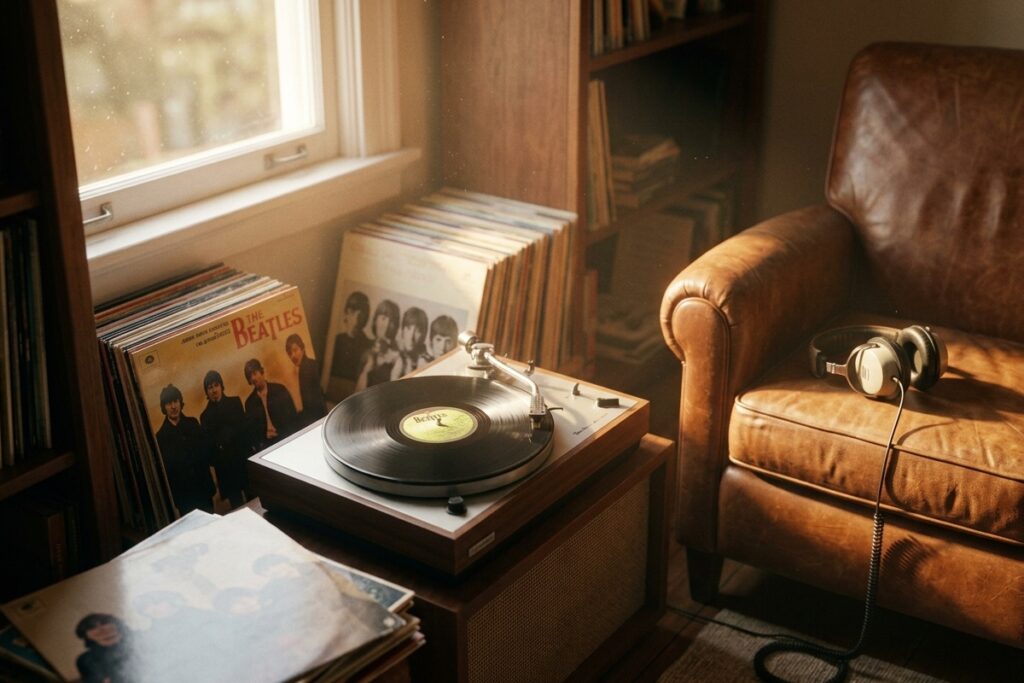
It is hard to pinpoint exactly when the transformation happened, but there is a distinct ‘before’ and ‘after’ in my life when it comes to music. Before I picked up my first Beatles record, I was a casual listener, content with whatever the radio chose to feed me. After that first needle drop on the grooves of Abbey Road, my entire sonic landscape shifted. The Beatles didn’t just become my favorite band; they became the lens through which I evaluate everything I hear today.
The influence started with the melody. Growing up, I thought songs were supposed to be predictable, following a standard verse-chorus-verse structure. Then came ‘A Hard Day’s Night.’ The opening chord—that suspended, ringing tension—felt like a jolt of electricity. It taught me that a song could be a surprise from the very first second. As I dove deeper into their discography, moving from the mop-top pop of their early years to the experimental psychedelia of Sergeant Pepper’s Lonely Hearts Club Band, I realized that music wasn’t a static commodity. It was a playground.
Their influence on my taste went beyond just the catchy hooks. It was about the audacity to experiment. Listening to the frantic, disjointed energy of ‘Happiness Is a Warm Gun’ forced me to stop looking for a safe, singular rhythm. Because of the Beatles, I found myself hunting for complexity in other artists. When I listen to modern indie bands or intricate rock groups, I find myself checking for those same ‘Beatles-esque’ qualities: tight vocal harmonies, unexpected key changes, and the inclusion of unconventional instruments. They ruined me for simple, boring music, and I have never been more grateful.
Another major shift was in how I understood the production side of music. The Beatles were pioneers of the studio as an instrument itself. From the tape loops in ‘Tomorrow Never Knows’ to the multi-tracked wall of sound in ‘Eleanor Rigby,’ they showed me that music is as much about architecture as it is about performance. Once you start noticing the cello quartet behind ‘Yesterday’ or the sitar work on ‘Within You Without You,’ you start listening to all music differently. You begin to peel back the layers, wondering how the sound was constructed rather than just letting it wash over you.
Perhaps most importantly, the Beatles taught me that music shouldn’t be defined by genre. I stopped seeing ‘rock,’ ‘pop,’ and ‘classical’ as separate islands. If the Fab Four could weave music-hall piano into a hard-rock track or bring in Indian classical musicians, then I had no excuse to pigeonhole my own taste. This opened the floodgates. My playlist now looks like a chaotic, beautiful mess—everything from bossa nova to heavy metal finds a home, simply because the Beatles gave me the permission to appreciate any sound that possessed a soul.
Today, when someone asks me what kind of music I like, I tell them that I like ‘Beatles-influenced’ music. Even if that means a band that was formed forty years after they broke up. It’s a standard of quality, a benchmark of songwriting, and a lifelong curiosity for sound that they instilled in me. They were the original architects of my musical identity, and I suspect that as long as I keep listening, they will always be at the heart of why I love music so much.